
How to Make a GTA 6-Style Game With AI — Free Code, Assets & Open-World Tutorial
Build your own coastal city with cars, pedestrians, missions and police pursuit. Choose a top-down, isometric or third-person approach and grow one working district into a lively open world.
Reimagine the mechanics in your own style: original characters, artwork and world. This independent guide builds Neon Harbour, rather than recreating GTA 6 or its commercial assets.
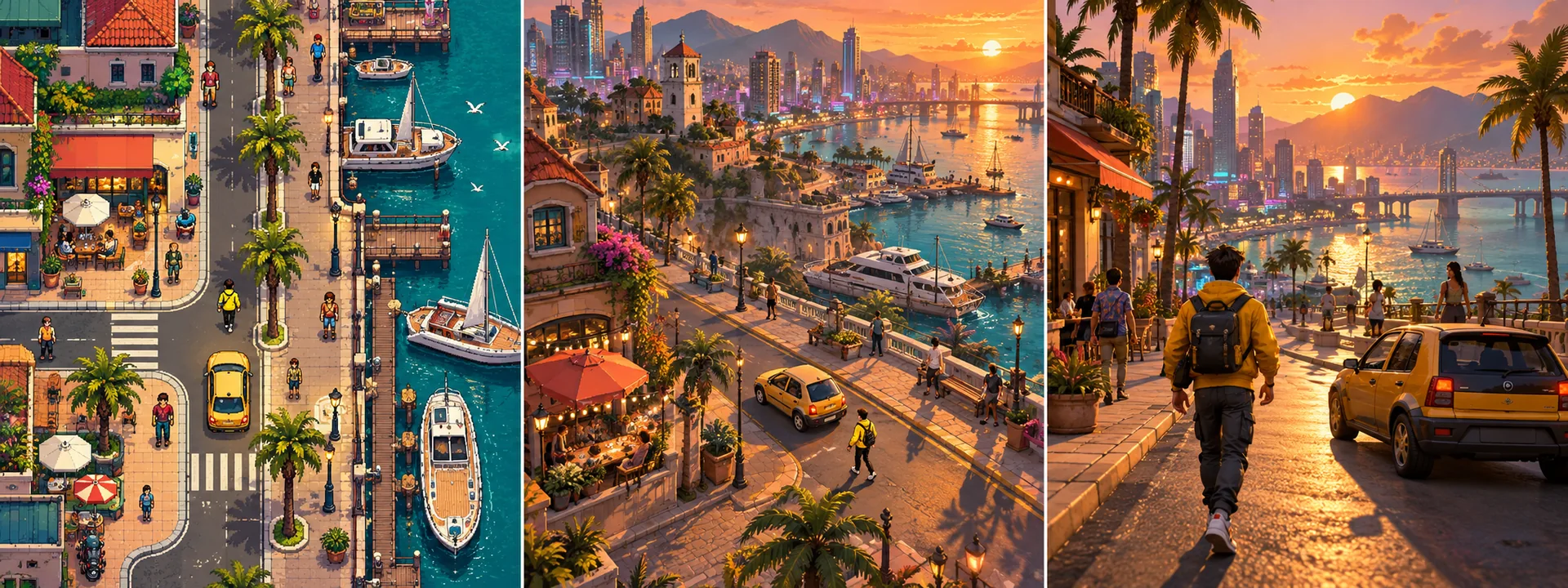
You are creating your own original game inspired by general mechanics. GTA 6 is a reference, not an exact-copy brief or official project.
Choose the game you can finish
Your first milestone: One six-block waterfront district, one enterable car, ten pedestrians, one delivery mission, one pursuit unit and a garage save. Finish this slice before multiplying maps, characters or mechanics.
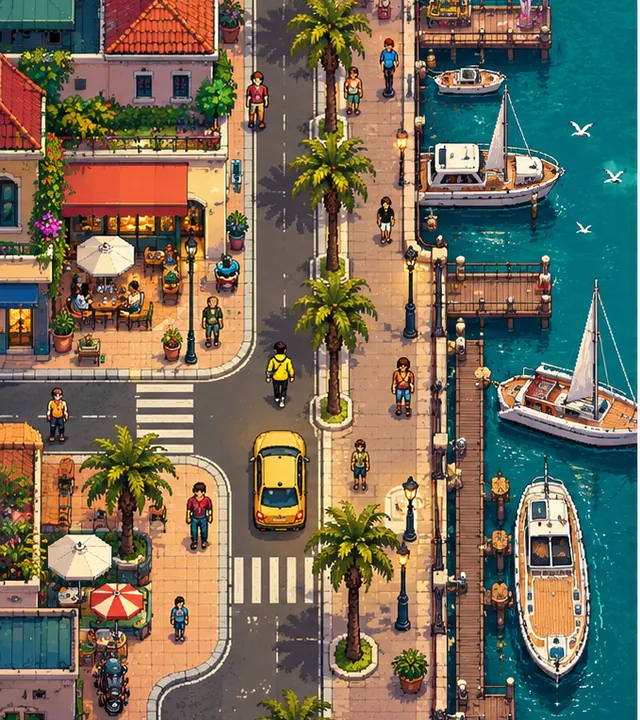
2D open world
Top-down sprites, a road tilemap and arcade driving. The simplest route to a browser-friendly city; traffic and pedestrians use a bounded local graph.
MAKE MY OWN 2D GAME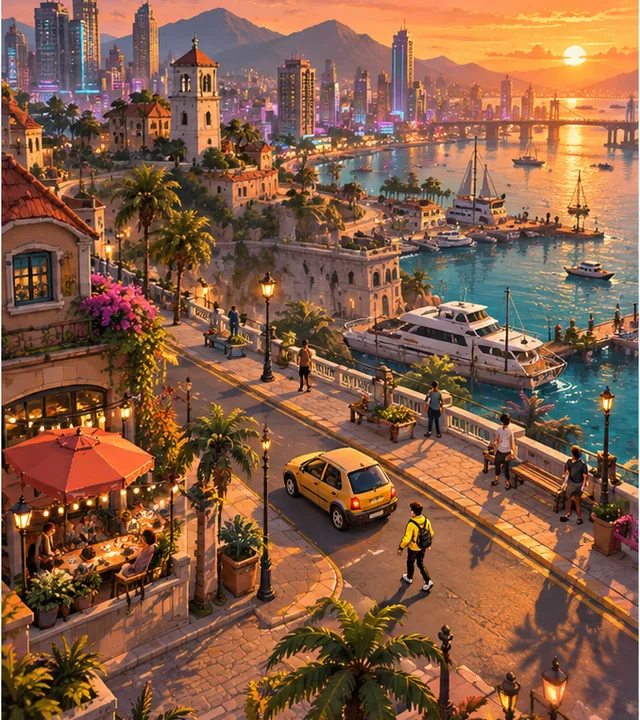
2.5D open world
A 3D district with an orthographic isometric camera. Roads and cars remain 3D; use height-aware collisions and sorting rather than rotating a flat screenshot.
MAKE MY OWN 2.5D GAME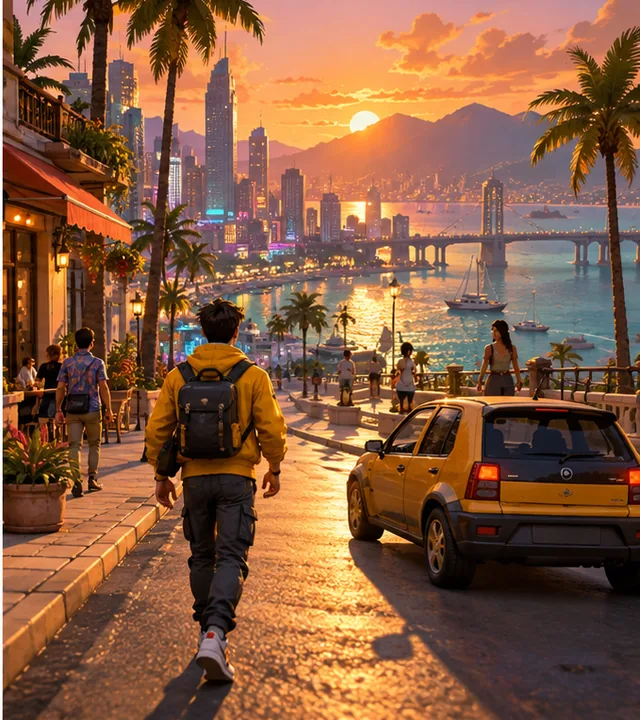
3D open world
A third-person character and chase camera, drivable vehicles and a small streaming district. Start desktop-first and profile before promising a mobile browser port.
MAKE MY OWN 3D GAMESee what original creators have built
Open Theft Auto
Procedural city composition, kinematic movement, vehicles, pedestrian logic, pursuit and saved state in GDScript. The repository includes AI work instructions; that does not prove how every file was authored. Study the system boundaries, then use original characters and separately cleared art.
Code and asset rights: MIT source; mixed third-party asset licences and brand references require separate review
Compatibility: Reference-only here. The pinned README asks for Godot 4.7+, while the repository description says 4.6. Inspect project.godot and test your editor; no certified export.
VIEW ORIGINAL GITHUB PROJECT ↗Source checked 11 October 2026 · pinned review; not whole-project runtime certification. Open the creator’s repository for genuine media; concept art here is separate.Godot demo projects
Feature-sized editor projects for movement, physics, tilemaps and UI. No verified AI-authorship claim.
Code and asset rights: MIT code; retain notices and inspect each demo’s asset credits
Compatibility: Use a demo branch matching your Godot editor; individual examples supply systems, not a complete game.
VIEW ORIGINAL GITHUB PROJECT ↗Source checked 11 October 2026 · pinned review; not whole-project runtime certification. Open the creator’s repository for genuine media; concept art here is separate.Godot 4 third-person controller
A third-person movement and camera example. Adapt its controller without assuming it supplies stamina, lock-on, a Soulslike combat system or commercial art. No verified AI-authorship claim.
Code and asset rights: MIT scripts/scenes/shaders; art is CC BY-NC-SA 4.0
Compatibility: Godot 4 controller code only for a commercial starter. Replace the non-commercial textures/models; test all scene references after removal.
VIEW ORIGINAL GITHUB PROJECT ↗Source checked 11 October 2026 · pinned review; not whole-project runtime certification. Open the creator’s repository for genuine media; concept art here is separate.Step by step: build Neon Harbour
These are an original implementation plan with explicit checks, not claims that every proposed engine integration has already been executed.
- STEP 1
Sketch a district, not an entire country
Lay out six blocks, a waterfront, garage and three mission markers. Reserve wide turns, pavements and a pedestrian route. Give every road and mission a stable ID.
Expected result: An original walkable city greybox with a clear starting location.
Try this check: Walk every junction and return to the garage without getting stuck.
2D · Original AI-generated concept · not gameplay - STEP 2
Reuse walking and camera code
Start with a matching Godot movement demo. Set move, run, interact, pause and camera actions in Input Map. Keep on-foot and driving controllers separate and route input to only the active one.
Expected result: Responsive movement with a chase or overhead camera.
Try this check: Enter a menu while holding movement, then close it: movement must not remain stuck.
Controls → state → feedbackEnter a menu while holding movement, then close it: movement must not remain stuck.
Acceptance check · run this in your own project - STEP 3
Make the first car fun
Use a simple kinematic arcade controller before complex wheel simulation. Clamp steering at speed, brake predictably and test reversing. Vehicle entry switches control; exit checks a clear pavement position.
Expected result: One car drives around the whole district.
Try this check: Exit beside a wall, reverse into a kerb and recover from leaving the road.
2.5D · Original AI-generated concept · not gameplay - STEP 4
Add people and traffic cheaply
Author pavement waypoints and directed lane edges. Keep walkers away from driving lanes. Update distant agents less often, cap visible population and recover an agent that cannot reach its next point.
Expected result: A lively street with bounded CPU work.
Try this check: Observe a crowded crossing and a blocked junction for two minutes.
Validate → change once → show resultObserve a crowded crossing and a blocked junction for two minutes.
Acceptance check · run this in your own project - STEP 5
Connect one mission to pursuit
Use explicit mission states: available, accepted, cargo collected, delivered. Pay once on the delivered transition. Pursuit needs awareness, last known location, searching and a cooldown; never instantly spawn a unit on the player.
Expected result: A delivery can trigger a readable short chase.
Try this check: Reload after delivery: the reward cannot be claimed again; losing sight must eventually end the pursuit.
3D · Original AI-generated concept · not gameplay - STEP 6
Dress the city and save the garage
Replace greyboxes with selected CC0 buildings and cars, keeping collisions simple. Add idle/run poses, wheel feedback, directional sound and a legible minimap. Save mission IDs, cash, car and player position with a schema version.
Expected result: A recognisable original coastal city and working resume flow.
Try this check: Load a missing/corrupt save safely; profile driving through the busiest block on the target device.
Save → reload → compareLoad a missing/corrupt save safely; profile driving through the busiest block on the target device.
Acceptance check · run this in your own project
Start with a working reference
The related 2D workshop has a smaller runnable practice loop and public source. It is separate from this multi-dimension production roadmap.
Open the practical starter workshop →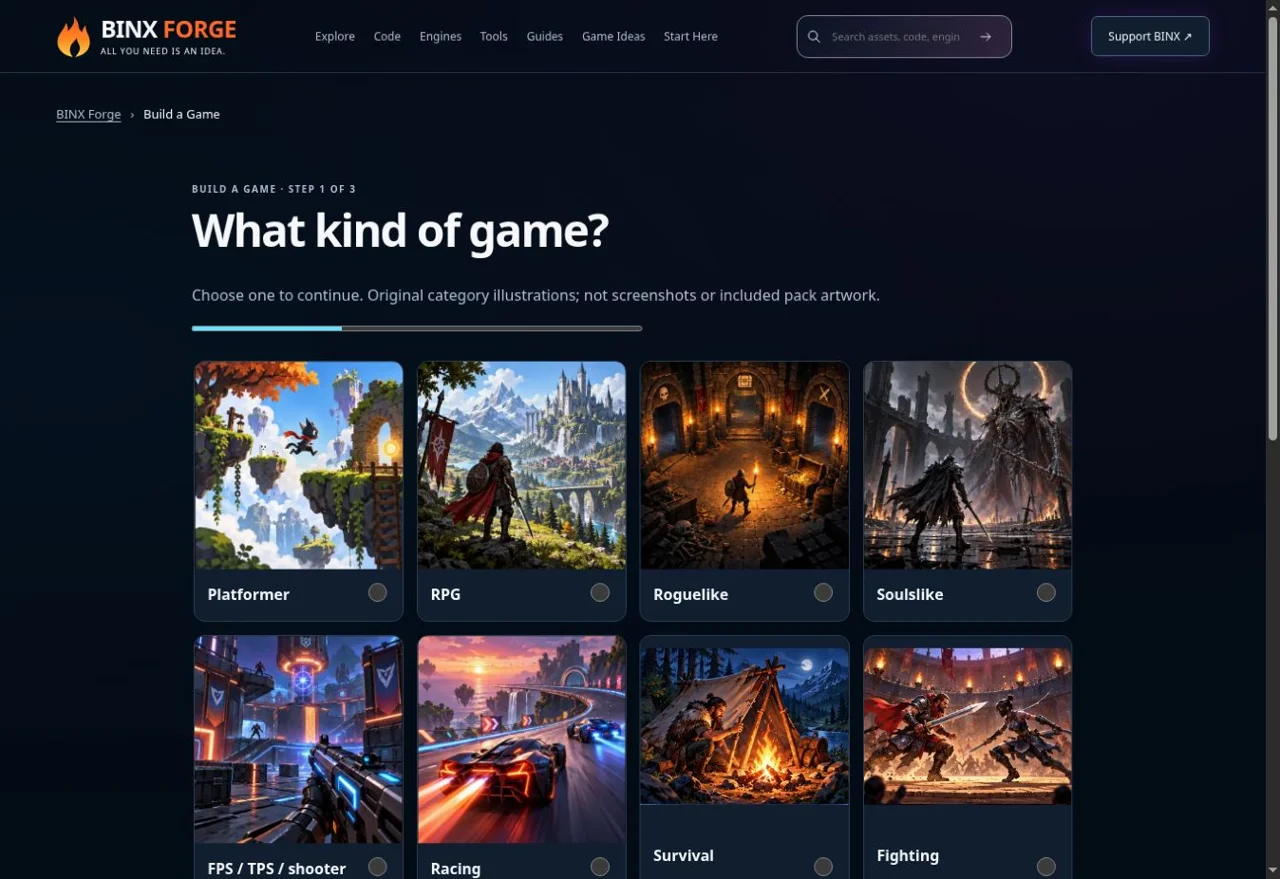
Free code, assets and systems you can reuse
Godot supplies physics, input mapping, UI controls, animation tools, navigation and file APIs. Its demos illustrate individual systems. Reuse those before asking ChatGPT, Claude Code or Codex to recreate them; AI still has to adapt your game-specific rules. Work avoided is not a measured credit-saving percentage.
Kenney City Kit (Suburban)
Original creator: Kenney.
CC0 · 3D buildings; import one street and check collision/scale.
View assets, real previews & licence ↗Kenney Racing Kit
Original creator: Kenney.
CC0 · 3D vehicles/track pieces; provides art, not driving physics.
View assets, real previews & licence ↗Kenney Tiny Town
Original creator: Kenney.
CC0 · 2D town tiles; choose a consistent sprite scale.
View assets, real previews & licence ↗Animation, UI, audio, inventory and saving
Keep one art scale and test one imported model or sprite first. Reuse engine animation states and native UI focus. Use original sound synthesis or an exact cleared audio pack. Define inventory/collection IDs and transaction rules as game data; a visual pack cannot implement those rules. Godot’s saving tutorial supplies a file-workflow starting point; add schema validation, migrations and error handling.
Godot saving tutorial ↗ · Animation integration guide · Add one code or asset resource
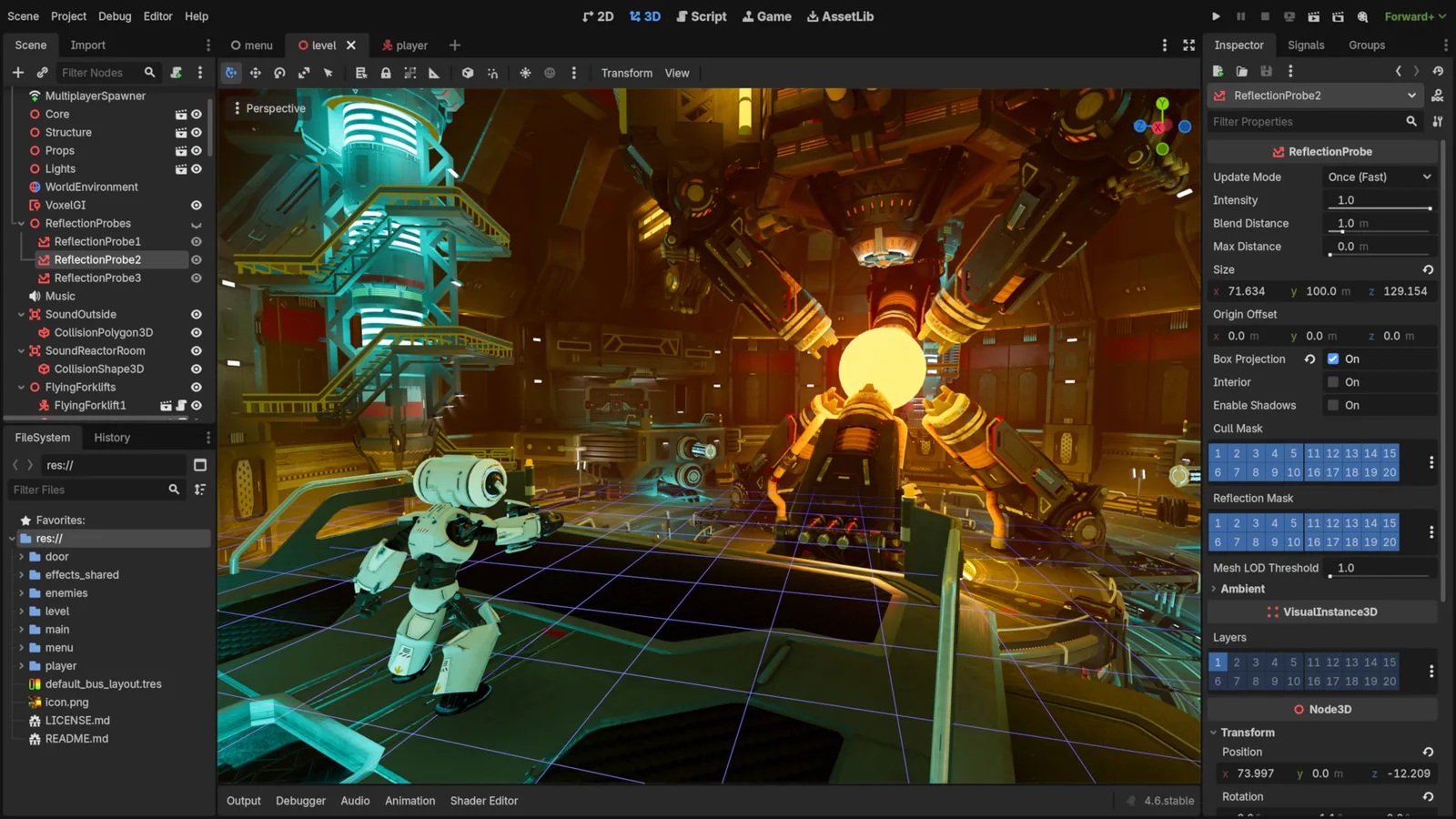
Godot Engine contributors · Original screenshot ↗ · CC BY 4.0 ↗. Resized and compressed.
Godot Engine contributorsGodot
Free, open-source game editor for 2D and 3D projects, with scene, animation and interface tools.
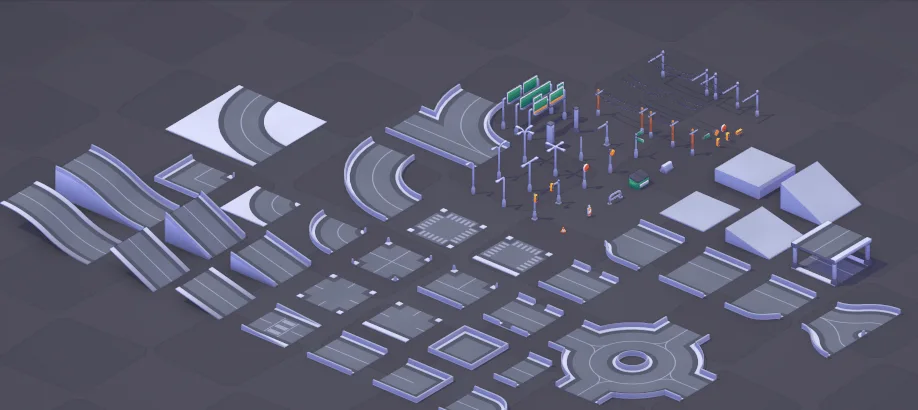
City Kit (Roads)
Road assets for city layouts and driving prototypes.
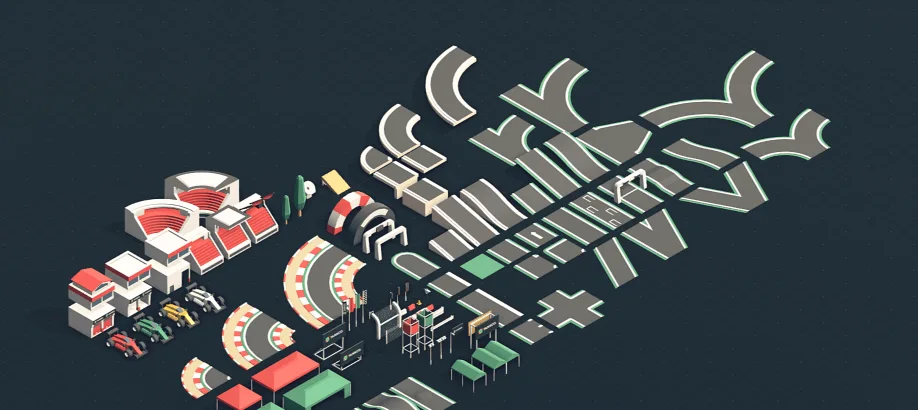
Racing Kit
Track and vehicle artwork for arcade racing scenes.
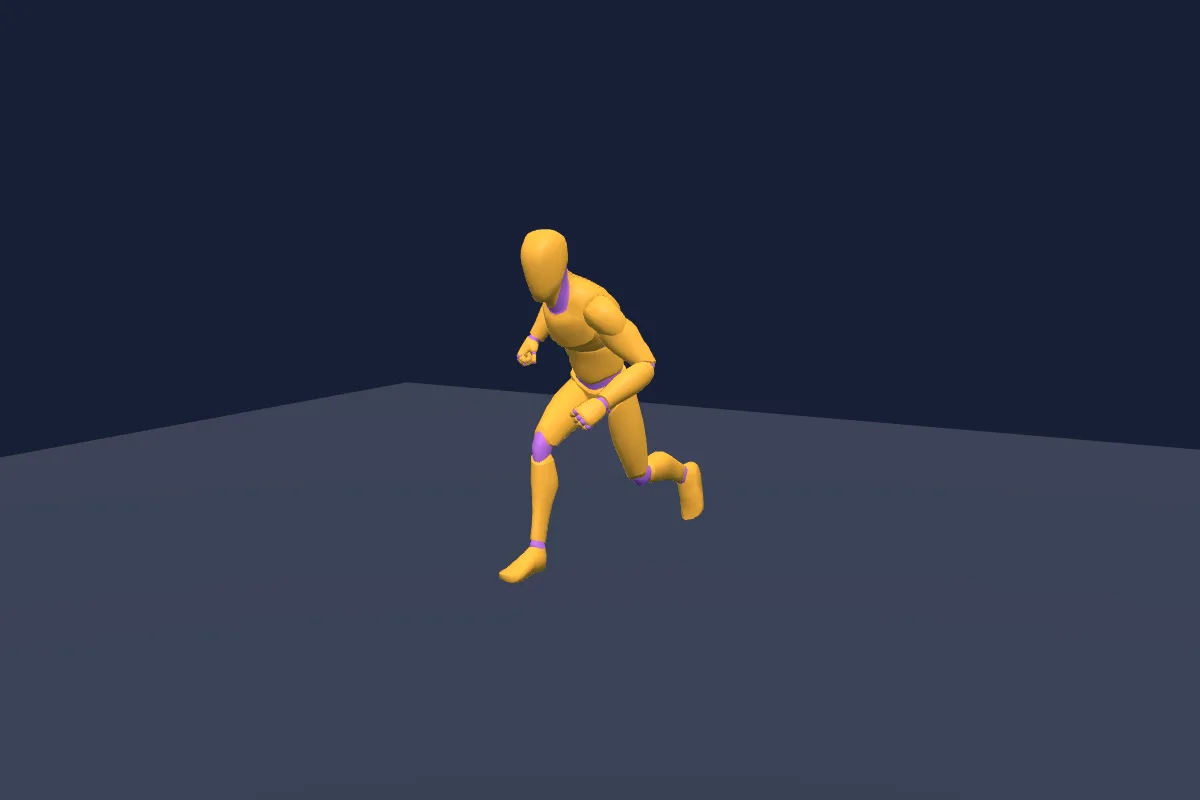
Universal Animation Library
Humanoid animation library with a free subset and expanded paid editions.
Optional paid assets are for an evidenced gap such as extra animation actions or a consistent environment set. Keep the free baseline beside the paid option. Browse free resources · Compare optional paid resources. Check current prices at the creator; no commission-based ranking or invented improvement percentage.
Licensing summary, not legal advice. Before selling or publishing, check exact official terms. Finished-game use, reselling raw files and including files in a source/template product are separate permissions; art, audio, trademarks and promotional media have separate rights.
COPY PROMPT TO YOUR AI
Copy to make your own game. Choose a dimension below; each complete prompt includes the original concept, source links, controls, systems, phased work, checks and upgrades. Nothing is sent to an AI automatically.
Review the prompt, then copy it or select its text manually.
Your 2D game-building prompt
Review or manually copy this prompt
Your 2.5D game-building prompt
Review or manually copy this prompt
Your 3D game-building prompt
Review or manually copy this prompt
Make Your Game Even Better
Readable mission routes
Add distance markers and a safe garage route before extra guns or map size.
Inspect the free resource and optional paid editions →
Review or manually copy this prompt
Traffic and witnesses
Add crossing priorities and witnessed offences with bounded agent updates.
Inspect the free resource and optional paid editions →
Review or manually copy this prompt
District streaming
Stream neighbouring districts, persist mission state by ID and compare frame time at district boundaries.
Inspect the free resource and optional paid editions →
Review or manually copy this prompt
Questions before you build
Can AI make GTA 6?
AI can help build a smaller original city game. A commercial-scale world, animation library and mission catalogue require far more production work than a copied prompt. Begin with one district.
Can I make this without coding experience?
An AI can explain and draft code, but you still need to run the project, inspect errors and test controls and saves. Start with the runnable workshop, use a supported engine, and ask for one small milestone at a time.
Will this save AI credits?
Reusing a controller, tilemap, UI component or verified asset can reduce rebuilding work. Credit use depends on your AI, prompt and iterations; no fixed saving is promised.