
How to Merge Two Games with AI: Game Mashups, Mods and Code
Explore Mario in Elden Ring, Skyrim + Minecraft and creator-reported AI crossover mods. Learn how game mashups work with complete original practice code.
Topics: AI game mashups · Vibe coding games · AI-assisted modding · Game crossover mods · Combine game mechanics · AI coding agents
By BINX Forge · Creator sources reviewed 10 October 2026
AI game mashups and game crossover mods attract attention because familiar mechanics collide in unexpected ways. “Merge two games” can mean several different engineering jobs. Start by choosing one host, one interface and one useful interaction. This guide explains public creator projects and teaches the method with two original modes and a complete source-only lab.
Mario in Elden Ring and other game mashup examples
| Creator project | How it works | What the evidence establishes |
|---|---|---|
| Mario in Elden Ring / ER Mario ↗ | Deltarooo’s Rust DLL runs libsm64 physics/animation against live host collision; the underlying host character follows, preserving host interactions and saves. | Runtime integration, not a model swap alone. The reviewed README does not claim AI use. It requires the creator-described local game/ROM inputs; those assets are not included here. |
| SkyCraft: Skyrim + Minecraft ↗ | Chasmlol’s SKSE plugin and Fabric mod communicate through shared memory. Minecraft logic runs in a hidden process while Skyrim remains the visible world, quests and NPC host. | Two runtimes bridged through an explicit interface. The reviewed README does not claim AI authorship. Experimental project; source reviewed, not executed here. |
| Elden Force ↗ | Creator Asher Sheets credits Claude as an AI coding agent, Nano Banana for concept art and Meshy for 3D models. The page describes rigging models to host skeletons and combining host motion/effects with hand-keyed additions. | Creator-reported AI assistance for code and asset work. Credits describe reuse of ER Mario/tooling; they do not establish a full AI rewrite or independently tested asset rights. |
| Project Genie world remix ↗ | Google describes sketching environments/characters from text/images, exploring an interactive world and remixing its prompt. Current help describes short experimental sessions and video download. | A generated world, distinct from combining source projects or compiled game runtimes. The cited workflow does not demonstrate export of a complete merged game codebase. |
These are author/vendor descriptions reviewed on 10 October 2026, not our own playtests. Melty describes a create/publish workflow that gives instructions to a coding agent. That is context for how creators use AI, not proof that every mashup uses AI or that any pair of games works. The commercial titles remain reference examples; their files are not bundled. Our worked example below is entirely original.
Vibe coding games, AI-assisted modding and world remixes
Use the name that fits the workflow you want to build.
- Vibe coding games
- Using natural-language requests to iterate on code with an AI assistant. In this guide, preserve a working baseline and verify each small change.
- AI-assisted game modding
- An assistant helps create or debug a plugin, script or asset workflow. Name the tools the creator actually credits; do not infer AI use from a dramatic result.
- Game mechanics mashup
- Original rules interact inside one game loop: collecting a token replenishes an arena ability. This is the approach used by the downloadable lab.
- Runtime bridge
- Two simulations exchange state through an adapter or protocol. SkyCraft describes a shared-memory bridge; ER Mario feeds host collision to libsm64.
- AI world model / world remix
- A model generates an explorable environment from prompts. Project Genie is a separate workflow from adapting game source code.
How to combine game mechanics without conflicting systems
Copying both projects into one folder does not resolve who owns time, physics, controls or saves. Keep one host authoritative and adapt each donor to a written contract.
| Conflict | Decision to make |
|---|---|
| Game loop and clock | One host advances both donors; cap stalls and use shared substeps. Donors never start their own loop. |
| Coordinates and collision | Define units, axes, origin and bounds; translate donor data at the adapter. Use host physics unless a separate simulation is explicitly bridged. |
| Player, camera and input | One controller owns movement/camera; map donor actions without two systems consuming the same key. Clear input on pause/focus loss. |
| Events and rewards | Use unique collection IDs and handle an event once. In our hybrid, one token grants one capped pulse charge. |
| Win, lose and restart | Host owns final results. Hybrid needs all tokens AND survival; zero health loses first. Restart creates fresh donor state. |
| Saves and identifiers | Version/namespaces must agree; keep backups and test roundtrips. This lab has no save integration. |
| Assets and permissions | Separate code licence from character/model/texture/game-input permissions. Link creator examples; bundle only the original lab. |
| Engine and performance | Same-language modules can share functions; different engines may need an exporter/plugin/process protocol. Bound queues/spawns and measure the real target. |
How to merge two games with AI, step by step
- STEP 1
Choose the kind of mashup
Distinguish a runtime mod, a bridge between games, an original mechanic blend and an AI-generated world.
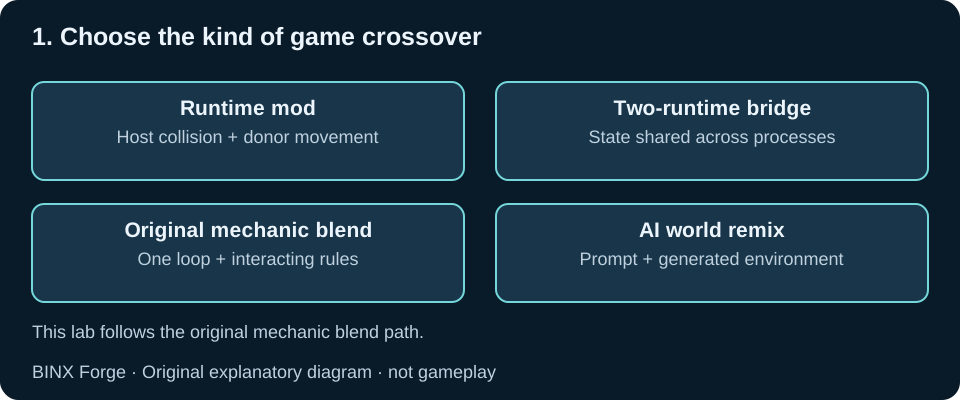
Original explanatory diagram: a runtime mod, two-runtime bridge, mechanic blend and AI world remix are separate workflows. If you own two source projects, first run each unchanged and record its controls, rules and target. For a retail crossover, the creator architecture and required local inputs are a different path. This guide does not install retail mods or supply game files.
- STEP 2
Choose one host and write the contract
Preserve the existing game loop and define coordinates, time, input, state, events and outcomes.
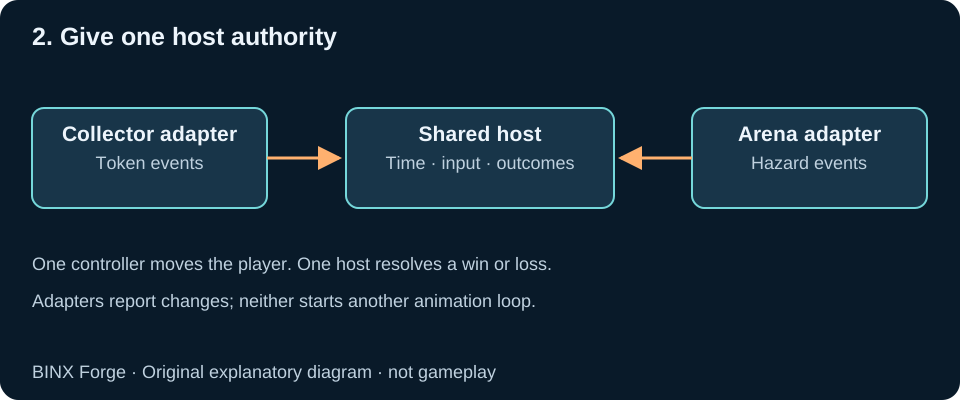
Original explanatory diagram: donor adapters report events; the host owns time, movement and final outcomes. In our lab the shared world is 640 × 360, speed 180 world pixels/second, time advances in at most 0.01 second substeps and long frames cap 0.1 second. The host controls movement and results; adapters return events.
- STEP 3
Adapt one donor at a time
Keep independent modes working; route donor events through the shared host rather than duplicating controllers or loops.
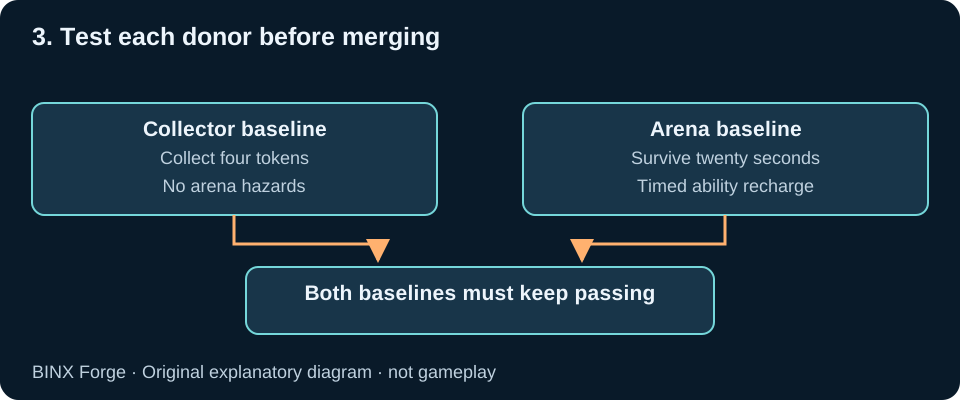
Original explanatory diagram: Collector and Arena each have a baseline check before integration. Run collector and arena separately before enabling hybrid. Collector wins at four tokens; arena wins after twenty seconds and refills pulse charges over time. Do not give either adapter an animation loop or a competing win screen.
- STEP 4
Make the mechanics interact
Connect a collection event to one arena pulse-charge refill; define a coherent combined win rule.
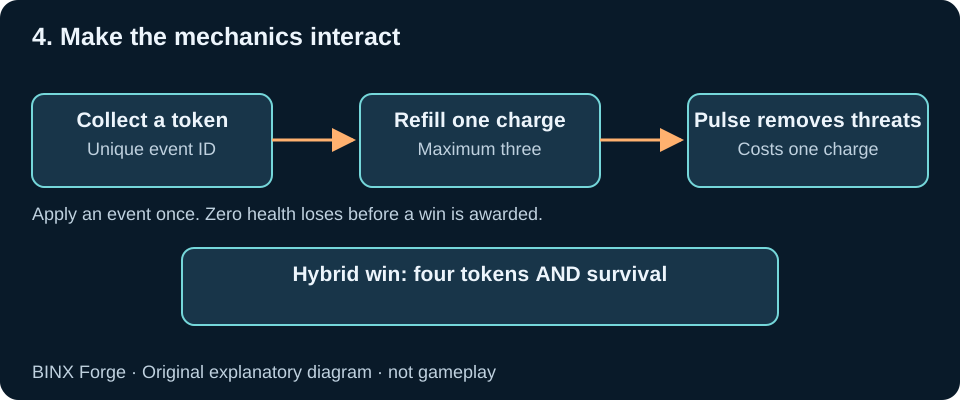
Original explanatory diagram: a token event refills one pulse charge, capped at three; the hybrid needs collection and survival. Hybrid replaces timed refill with collection refill. Collecting a token produces one unique event, grants one charge up to three, and never wins early. Survive AND collect; loss takes priority. This interaction makes a mechanic blend rather than two unrelated minigames.
- STEP 5
Use AI in small, testable changes
Review proposed files, execute baseline/adapter/hybrid checks, compare evidence and test the target controls before shipping.
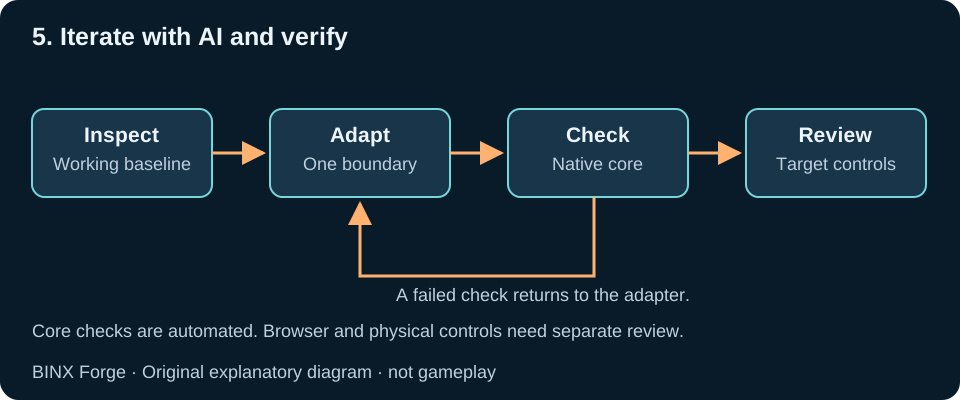
Original explanatory diagram: inspect, adapt, run checks, then review target controls. A failed check sends you back to the adapter. Ask your coding assistant to change one boundary, show complete changed files and add a check that can fail. Inspect the diff and execute the check. A polished generated video or decompiler screenshot does not establish a working code integration. Test the browser/device controls after the native core.
Original worked code: Collector + Arena = Token Pulse
Download the complete original merge labcollector.mjs · arena.mjs · host.mjs · check.mjs · input.mjs · serve.mjs · index.html · style.css · main.mjs · README.md · LICENSE.txt · files.mjs
Extract the whole merge-lab folder. Requires Node24; no packages or game assets to install. Keep its MIT notices.
node check.mjs
node serve.mjs
The first command should report 22 passing native core checks. The second prints a localhost URL for manual practice; stop with Ctrl+C. Keep all files together and use the local helper rather than double-clicking HTML. Do not expose this helper as a public server.
Compare the Collector, Arena and Hybrid selector modes. Move with WASD/arrows or direction buttons, use Pulse, then try pause/resume, leave/return and restart. These are manual acceptance instructions; browser/render/keyboard/touch/device checks remain OPEN. The canvas uses original procedural circles. This V1 teaching probe is not a complete BINX.fun V2 game.
The shared host and interaction
Read host.mjs: one controller, two adapters and the hybrid win rule
/* Original Forge merge host; shared timing/motion pattern from Pocket Engine1.0. MIT. */
import {createTokens,collect} from './collector.mjs';
import {arenaStep,pulse} from './arena.mjs';
export const modes=['collector','arena','hybrid'];
const clamp=(n,a,b)=>Math.max(a,Math.min(b,n));
export function createState(mode='hybrid'){
 if(!modes.includes(mode))throw Error('Choose collector, arena or hybrid');
 return {mode,status:'ready',age:0,remaining:20,player:{x:320,y:180},tokens:mode==='arena'?[]:createTokens(),hazards:[],collected:0,defeated:0,hp:3,charges:1,spawnClock:3,chargeClock:3,invulnerable:0,nextHazard:0,pulseHeld:false,events:[]};
}
export function start(mode='hybrid'){const s=createState(mode);s.status='running';return s;}
export function togglePause(s){if(s.status==='running')s.status='paused';else if(s.status==='paused')s.status='running';s.pulseHeld=false;}
export function step(s,input={},dt=0.01){
 if(s.status!=='running'||!Number.isFinite(dt)||dt<=0||dt>0.01+1e-9)return;
 s.events=[];s.age+=dt;
 const dx=Number(!!input.right)-Number(!!input.left),dy=Number(!!input.down)-Number(!!input.up),length=Math.hypot(dx,dy)||1;
 s.player.x=clamp(s.player.x+dx/length*180*dt,14,626);s.player.y=clamp(s.player.y+dy/length*180*dt,14,346);
 if(s.mode!=='arena')for(const event of collect(s)){s.events.push(event);s.collected++;if(s.mode==='hybrid')s.charges=Math.min(3,s.charges+1);}
 if(s.mode!=='collector'){
  s.remaining=Math.max(0,s.remaining-dt);s.chargeClock-=dt;
  if(s.mode==='arena'&&s.chargeClock<=0){s.chargeClock+=3;s.charges=Math.min(3,s.charges+1);}
  if(input.pulse&&!s.pulseHeld)for(const event of pulse(s)){s.events.push(event);s.defeated+=event.removed;}
  s.pulseHeld=!!input.pulse;
  for(const event of arenaStep(s,dt)){s.events.push(event);if(event.type==='damage')s.hp-=event.amount;}
 }
 // Exactly one host owns outcomes. Donors report events and never start loops.
 if(s.hp<=0)s.status='lost';
 else if(s.mode==='collector'&&s.collected===4)s.status='won';
 else if(s.mode==='arena'&&s.remaining===0)s.status='won';
 else if(s.mode==='hybrid'&&s.collected===4&&s.remaining===0)s.status='won';
}
export function advance(s,input,elapsed){
 if(!Number.isFinite(elapsed)||elapsed<=0)return;
 const dt=Math.min(0.1,elapsed),count=Math.ceil(dt/0.01);
 for(let i=0;i<count&&s.status==='running';i++)step(s,input,dt/count);
}
Inspect all 22 native checks · Read scope and reuse notes · Keep the original permission notice
Reuse first: the input and local helper are existing owned Pocket Engine code; shared movement/timing and bounded wave/contact patterns adapt existing Forge labs. The new host/event/refill glue fills the integration gap. Existing donor projects and private BINX games stay intact.
AI game mashup and crossover mod questions
How did Mario in Elden Ring work?
The ER Mario README describes libsm64 simulation connected to host collision through a Rust DLL; the host character follows the simulated character. That is a runtime adapter. Its reviewed README does not claim AI authorship. Read the creator source for its exact requirements and limitations.
Can AI merge any two games into one?
There is no universal guarantee. Engine/runtime access, coordinates, collisions, controls, save formats and asset permissions can prevent an integration. AI can help inspect interfaces and write adapters; working baselines and target tests establish whether it works.
Is an AI world remix the same as a merged game?
No. Project Genie describes generating/remixing an interactive world and downloading video. A source-code merge or runtime bridge requires explicit executable interfaces, state and testing.
How do I make an original game mashup instead of a retail mod?
Blend broad mechanics using your own source and assets. Start with a single host and a small interaction, such as collecting tokens to refill an arena ability. This lab supplies that complete original practice code.
What should I ask an AI coding agent to do first?
Inspect my existing game, preserve its working loop and propose an adapter contract for one donor mechanic. Define units, inputs, events and win/reset behavior, show changed files and report actual checks. Use the complete brief below.
Take the complete merge guide and code to your AI
Review before sharing. You can select the text manually.
Review the creator examples, contract and complete original source
22 actual native core checks pass. Simulated frame timing does not certify hardware performance. Browser/render/controls/clipboard/device/assistive and other platforms remain OPEN. Creator projects were source-reviewed, not executed; reported AI use and asset rights remain separately scoped. Search volume, Google indexing, AI citation and ranking results are not measured.
Read the creators’ original sources
- Deltarooo: ER Mario source and runtime architecture ↗
- Chasmlol: SkyCraft source and bridge architecture ↗
- Asher Sheets: Elden Force creator credits and method ↗
- Melty: creator workflow and published mashups ↗
- Google DeepMind: Project Genie world remix workflow ↗
- Google: current Project Genie experimental limits ↗
Understand game mechanics with original reverse-engineering practice · Build your own shared game modules · AI game development guide · All Forge guides